The European Times: Falun Dafa Practitioners Persevere Despite Pressure
(Minghui.org) May 13 is a special day for Falun Dafa practitioners around the world because this is the date that the practice was first introduced to the public in 1992. Each year, practitioners celebrate May 13 with parades, rallies, and community events to raise awareness of this traditional spiritual practice and the ongoing persecution of the practice in China, the land of its origin.
A recent article published in The European Times on May 14, 2026, titled “Falun Dafa Day Highlights Faith Under Pressure,” explores the significance and nuances of the annual worldwide Falun Dafa Day celebrations.
“For followers, the anniversary is primarily a day of faith, discipline and thanksgiving. Falun Dafa’s official materials describe the practice as rooted in Buddhist tradition and centred on the principles of truthfulness, compassion and forbearance,” stated the article. “Its website says the practice is now followed in more than 100 countries and that its teachings have been translated into more than 50 languages through FalunDafa.org.”
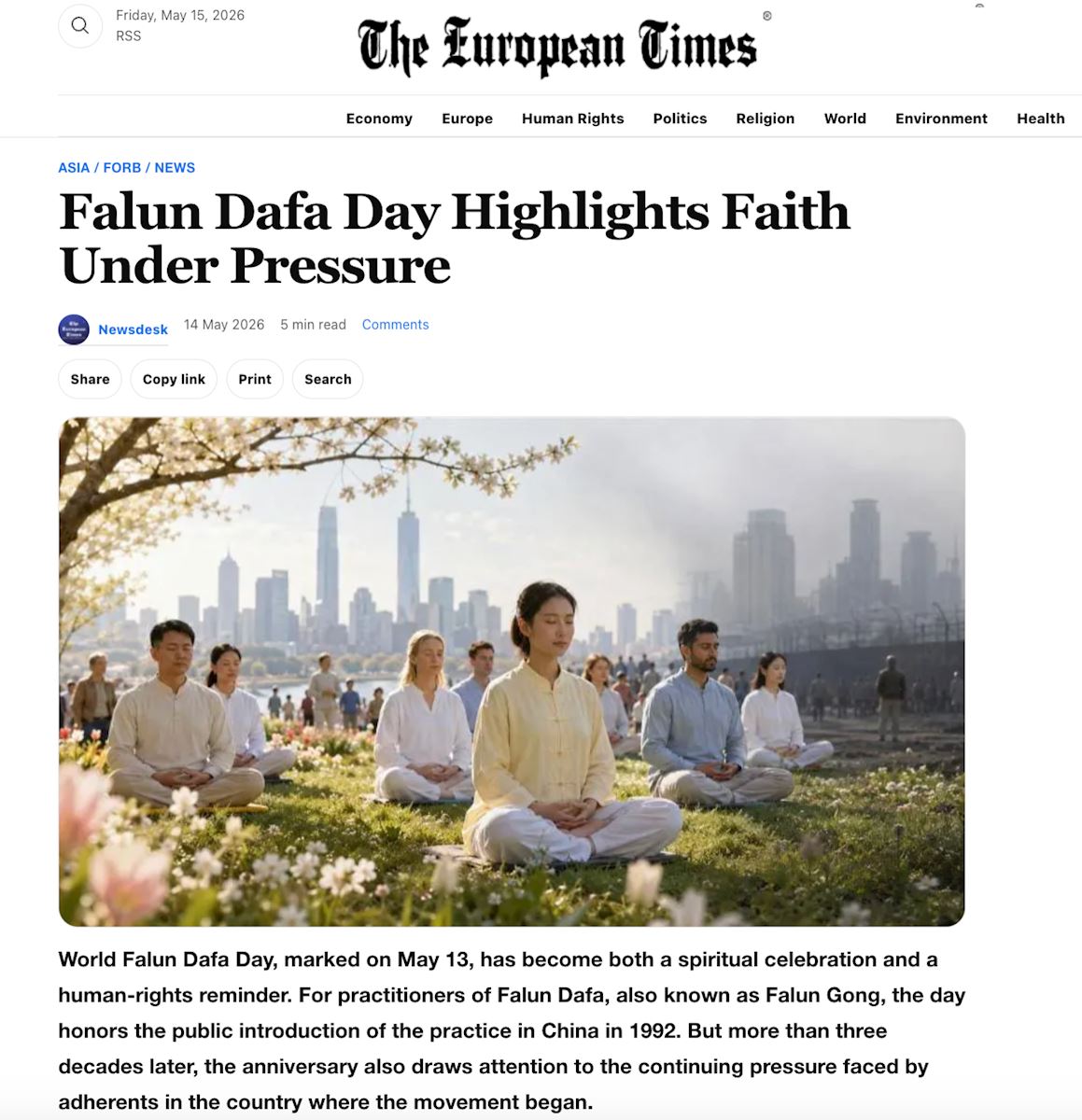 An article about Falun Dafa was published in The European Times on May 14, 2026 (Screenshot courtesy The European Times)
Suppression and Perseverance
Falun Dafa (also called Falun Gong) was introduced in China. While the teachings are consistent with traditional Chinese culture, the practice has nonetheless faced harsh persecution by the Chinese Communist Party (CCP), a regime known for repressing various groups since it took power in 1949.
“The Chinese authorities banned the movement in 1999 and have since treated it as a threat to state authority. That official hostility has shaped the way the anniversary is observed: openly in many countries, cautiously or privately inside mainland China,” noted the article.
A great deal of evidence, including data from The UK Home Office, states that practitioners in China may face harassment, arrest, detention, long prison sentences, and pressure to renounce their belief.
The article said that the victims of the CCP’s religious suppression are not limited to Falun Gong practitioners. “Freedom House reported in its 2025 China assessment that several religious and belief communities, including Falun Gong practitioners, Tibetan Buddhists, Muslim groups and Christian house churches, face harsh persecution under policies aimed at tightening state control over religious life,” the article explained.
Celebrating Falun Dafa Day is not only a testimony to the practice’s benefits, but also to practitioners’ perseverance despite adversity. The article explained, “In democratic societies, practitioners may gather in parks, walk in parades, practise meditation in public spaces and share their beliefs openly. In China, according to Falun Gong-linked reports and international human-rights documentation, association with the practice can still carry serious risks. This contrast has turned May 13 into a global symbol of a community that remains visible despite pressure.”
This also poses a question for governments and international institutions. “How should the world respond when a state treats independent spiritual organisation as a political danger?”
Organ Harvesting
Unfortunately, what Falun Gong practitioners are subjected to go beyond detention and torture. “One of the most serious dimensions of the Falun Gong case is the long-running allegation of forced organ harvesting from prisoners of conscience. China denies such allegations. However, international concern has not disappeared,” the article stated.
The United Nations and the European Parliament are aware of the issue. UN human-rights experts said in 2021 that they were alarmed by reports that detainees from ethnic and religious minorities, including Falun Gong practitioners, were allegedly subjected to medical testing and organ removal without consent. The European Parliament also adopted a resolution in 2022 based on reports of continued organ harvesting in China, calling for EU institutions and member states to address the issue and prevent complicity in unethical transplant practices.
“These allegations have made Falun Gong not only a religious-freedom case, but also a question of medical ethics, international accountability and the responsibility of states to prevent abuses linked to detention systems,” noted The European Times article.
Significance of the Celebration
Falun Dafa Day is more than a celebration: “It is a reminder that belief communities survive through memory, practice and public witness. For Falun Dafa practitioners, the day affirms gratitude and continuity. For human-rights observers, it highlights the fragility of conscience when governments restrict spiritual identity, association and expression,” the article explained.
Historically, political repression cannot erase faith. It is more so with Falun Gong’s teachings, which are based the principles of Truthfulness, Compassion, and Forbearance. These universal values underscore the importance of humanity.
“As celebrations continue around the world, the central message is both simple and demanding. Freedom of belief is not fully protected when it is reserved only for approved communities,” the article concluded. “It is protected when even unpopular, misunderstood or politically inconvenient groups can live their faith openly and peacefully.”